


When establishing a company in Vietnam, especially a foreign-invested enterprise, many individuals often raise the question: is it possible to be both an investor and a Director? This is a practical matter because investors often do not merely contribute capital but also wish to directly run the business, sign contracts, manage personnel, work with partners, and take responsibility for business activities in Vietnam.
In principle, an individual can concurrently be an investor and hold the title of Director or General Director of the company, provided they meet the conditions prescribed by law and the company’s charter. However, in cases where the investor is a foreigner, additional consideration must be given to issues regarding residency, work permits, management titles, legal representatives, tax obligations, and the scope of authority within the company.
The article below will analyze the scenarios where an investor can simultaneously serve as a Director, the conditions to bear in mind, and the common risks encountered when arranging the managerial personnel structure in an enterprise.
Legal Basis
- Law on Enterprises 2020;
- Law on Investment 2020;
- Labor Code 2019;
- Decree No. 152/2020/ND-CP regulating foreign workers working in Vietnam;
- Decree No. 70/2023/ND-CP amending and supplementing several regulations on foreign workers working in Vietnam;
- The company’s charter and relevant internal documents.
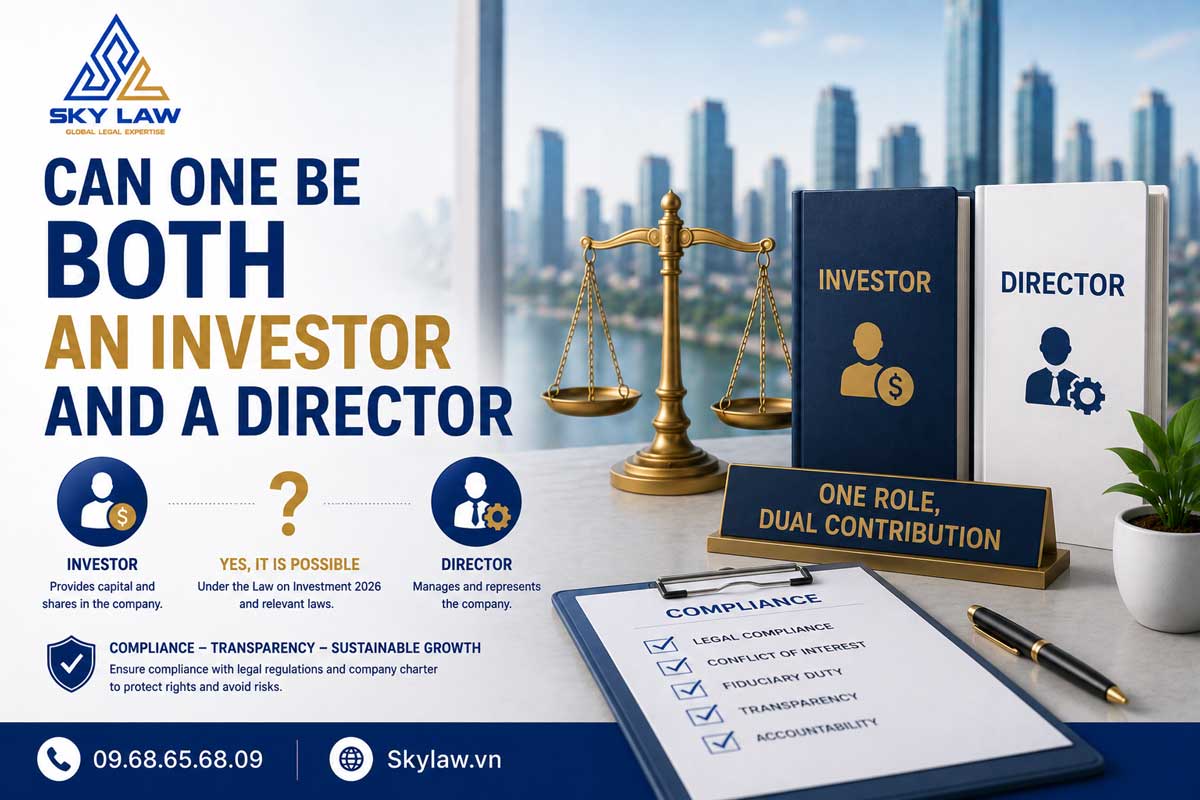
I. INVESTOR AND DIRECTOR ARE TWO DIFFERENT ROLES
1.1. An investor is a person who contributes capital to the company
An investor is an individual or an organization that contributes capital to establish an enterprise, purchases capital contributions, buys shares, or implements an investment project. For foreign-invested companies, a foreign investor can be an individual holding foreign nationality or an organization established under foreign law.
The primary role of an investor is to contribute capital, own capital contributions or shares, and enjoy benefits corresponding to their ownership ratio. Investors may receive profits, participate in deciding important matters of the company, transfer capital, or exercise other rights in accordance with the law and the company’s charter.
However, being an investor does not automatically equate to directly running the company’s day-to-day operations. Operational authority depends on whether the investor is appointed as the Director, General Director, legal representative, or to another management title.
1.2. A Director is the person who runs business operations
The Director or General Director is the person who manages and runs the daily business operations of the company. Depending on the type of enterprise, the Director can be appointed by the owner, the Board of Members, or the Board of Directors.
A Director generally has the power to organize the implementation of business plans, sign contracts within their competence, recruit personnel, manage assets, direct specialized departments, and take responsibility for operational outcomes within their assigned scope.
Therefore, when asking whether one can be both an investor and a Director, it is crucial to clearly distinguish between these two capacities. One person can simultaneously be the capital owner and the executive leader, but an appointment decision or an appropriate recognition mechanism in the company’s corporate records is required.

II. IS IT POSSIBLE TO BE BOTH AN INVESTOR AND A DIRECTOR?
2.1. In principle, concurrent holding of roles is permissible
According to corporate governance practices, an individual is completely permitted to be both an investor and a Director of a company. For example, a foreign individual who contributes capital to establish a single-member limited liability company in Vietnam can simultaneously be appointed as the Director to directly run the company.
Similarly, in a multi-member limited liability company (with two or more members) or a joint-stock company, a capital-contributing member or a shareholder can also be appointed as the Director if they meet the conditions and are approved by the competent authority within the company.
This dual-role holding is often suitable for small businesses, startups, newly established enterprises, or companies where investors wish to directly control business activities in Vietnam.
2.2. Case where the investor is a Vietnamese citizen
If the investor is a Vietnamese individual, being both an investor and a Director is usually quite straightforward. This individual needs to satisfy the general conditions for enterprise managers under the Law on Enterprises 2020 and must not fall into categories prohibited from managing or establishing enterprises.
In a single-member limited liability company, the owner can serve as the Director themselves or hire another person to be the Director. In a company with multiple members or shareholders, the appointment of the Director must be carried out in accordance with the charter and decisions of the internal governing body.
2.3. Case where the investor is a foreigner
If the investor is a foreigner, the answer remains yes, but it is necessary to consider additional regulations regarding foreign workers working in Vietnam. A foreigner who directly works and runs a company in Vietnam may have to carry out procedures related to work permits or verification of exemption from work permits, depending on each specific case.
Decree No. 152/2020/ND-CP and Decree No. 70/2023/ND-CP regulate various categories of foreign workers, including managers, chief executive officers, experts, and technical workers. Therefore, if a foreign investor holds the title of Director and directly works in Vietnam, the enterprise must check whether this person is subject to applying for a work permit or is exempt from a work permit.
In certain cases, foreign investors who contribute capital at a specified ratio or hold management positions may be considered for a work permit exemption; however, they still need to complete the verification or notification procedures as prescribed, depending on each specific case.

III. WHAT TO NOTE WHEN AN INVESTOR CONCURRENTLY SERVES AS A DIRECTOR?
3.1. Title and authority must be clearly defined
When an investor concurrently serves as a Director, the enterprise must clearly record the title, authority, and scope of representation in the charter, appointment decisions, or relevant contracts. It should not merely be implicitly understood that a capital contributor naturally has the right to sign all documents of the company.
In many cases, the right to sign contracts depends not only on the title of Director but also on whether that person is the legal representative or possesses a valid power of attorney.
Therefore, the enterprise needs to clarify: who the legal representative is, what types of contracts the Director has the right to sign, what the transaction value limit is, and whether approval from the owner, the Board of Members, or the Board of Directors is required.
3.2. Work permit conditions for foreigners must be checked
If the investor is a foreigner and directly runs the company in Vietnam, the issue of work permits is a matter that should not be overlooked. Many enterprises assume that simply being an investor allows them to freely act as a Director and work in Vietnam without any other procedures. This understanding may be incomplete.
Enterprises need to check the capital contribution ratio, management titles, working duration in Vietnam, type of company, and conditions for work permit exemption, if applicable. Even if they fall under the work permit exemption category, the enterprise may still need to perform procedures to obtain a certificate of work permit exemption as regulated.
Failing to properly handle procedures for foreign nationals working in Vietnam can lead to risks regarding labor, residency, and administrative sanctions.
3.3. Ownership rights and operational rights must be separated
Even though one person can be both an investor and a Director, enterprises should still separate capital ownership rights from day-to-day operational rights. An investor has rights in their capacity as an owner, member, or shareholder. A Director has rights and responsibilities in their capacity as an executive.
This separation helps avoid confusion in corporate governance. For instance, not every decision made by the Director is a decision of the owner or the Board of Members. Conversely, not all rights of an investor can be executed directly through the title of Director if the charter or the law requires internal approval.
For companies with multiple investors, this separation is even more vital to prevent disputes over signing authority, expenditures, recruitment, asset transfers, or profit distribution.
3.4. Personal tax and residency obligations must be noted
If a foreign investor is simultaneously the Director and receives a salary in Vietnam, the enterprise must consider personal income tax obligations, tax residency status, labor contracts or appointment decisions, as well as relevant reporting obligations.
Furthermore, if the foreigner resides in Vietnam regularly to run the company, matters concerning visas, temporary residence cards, work permits, or work permit exemption certificates must be properly prepared. This is a set of procedures that typically accompanies a foreign investor directly managing a business in Vietnam.
IV. SOME COMMON RISKS
4.1. Lack of a clear appointment decision
A common risk is that the investor practically runs the company, but internal records do not contain a Director appointment decision or fail to record specific authority. This can cause difficulties when working with banks, partners, state agencies, or when internal disputes arise.
4.2. Confusion between the Director and the Legal Representative
A Director is not always the legal representative. If the Director is not the legal representative, the authority to sign off on certain transactions may require a power of attorney or internal approval.
Enterprises need to check the Business Registration Certificate, the company’s charter, and internal decisions to correctly identify the person with the appropriate representative authority.
4.3. Ignoring labor procedures for foreigners
For foreign investors acting concurrently as Directors, bypassing procedures for work permits or certificates of work permit exemption can create legal risks. Enterprises should review this issue right from the setup of the management structure, rather than waiting until an inspection occurs or when applying for a temporary residence card.

V. FREQUENTLY ASKED QUESTIONS
5.1. Can a foreign investor serve as the legal representative?
Yes, they can. A foreign investor can serve as the legal representative if they meet the conditions prescribed by law and are recorded in the business registration documents. However, additional attention must be paid to residency, labor, and signing authority.
5.2. Is it mandatory for a Director to be a capital-contributing member?
No, it is not mandatory. A company can appoint a capital-contributing member, a shareholder, or an externally hired person as the Director, depending on the charter and decisions of the internal governing body.
5.3. Does a foreign investor concurrently serving as a Director need a work permit?
It depends on each case. If the foreigner directly works in Vietnam, the enterprise must check whether this person falls under the category of applying for a work permit or is exempt from a work permit according to regulations. Even if they are exempt, a verification or notification procedure may still be required.
CONCLUSION
It is entirely possible to be both an investor and a Director if that individual meets the conditions prescribed by law and is validly appointed within the company’s governance structure. This is a common model for small businesses, startups, newly established companies, or foreign-invested companies where investors wish to directly run operations in Vietnam.
However, enterprises must clearly differentiate among the roles of an investor, a Director, and a legal representative. For foreign investors, extra attention must be paid to work permits or work permit exemptions, tax obligations, residency, and signing authority. Proper preparation from the very beginning will help the company operate stably, mitigate legal risks, and avoid disputes during the course of enterprise management.


