


When establishing a foreign-invested enterprise in Vietnam, one of the crucial elements that investors must determine is the investment capital, charter capital, and the capital contribution plan. This information is not only recorded in the investment registration dossier and enterprise registration dossier, but it also directly impacts the project’s implementation capacity, capital contribution obligations, the ability to obtain sub-licenses, and subsequent business operations.
However, in reality, many investors fail to properly assess the importance of capital registration. There are cases where the registered capital is too low compared to actual business needs, cases where the registered capital is too high but not fully contributed on time, and instances of confusion between charter capital and investment capital. These errors can cause difficulties for businesses when applying for licenses, expanding operations, working with banks, or adjusting post-establishment dossiers.
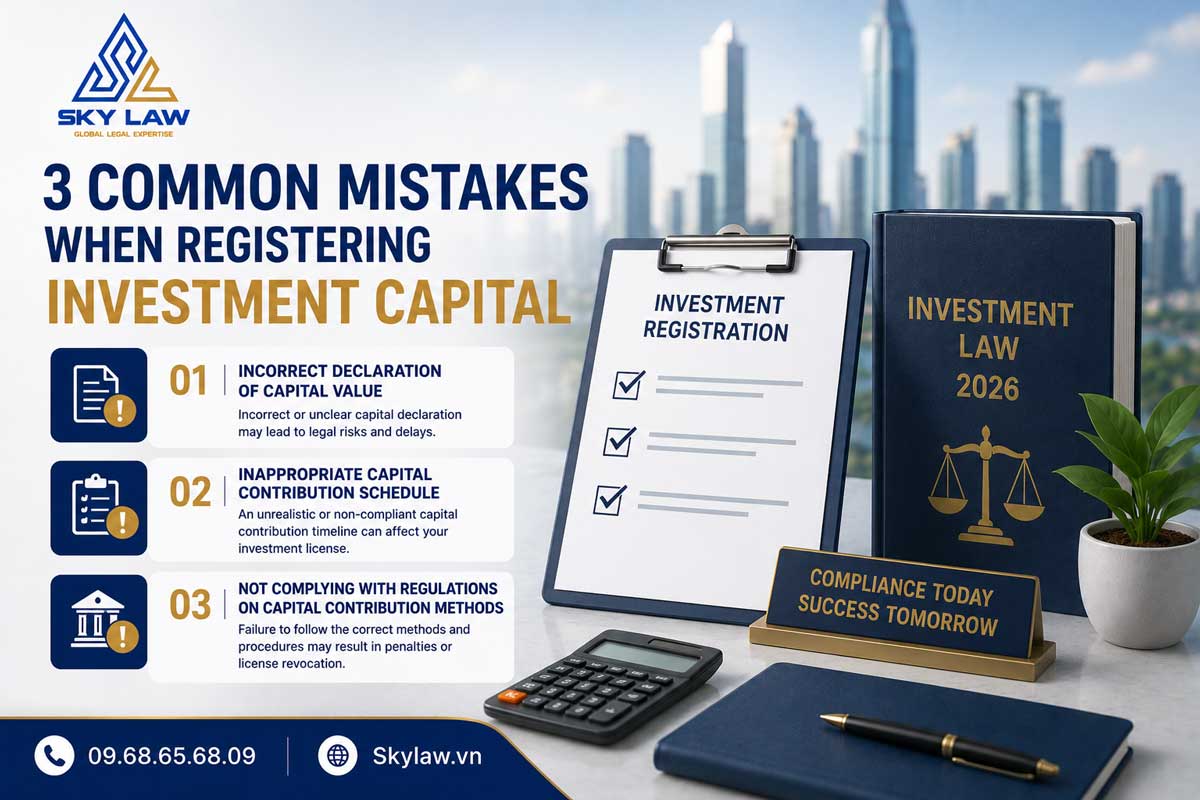
The article below will analyze 3 common mistakes when registering investment capital and provide notes to help investors prepare more appropriate dossiers.
Legal Basis
- Law on Investment 2020;
- Law on Enterprises 2020;
- Decree No. 31/2021/ND-CP guiding the Law on Investment;
- Decree No. 01/2021/ND-CP on enterprise registration;
- Specialized legal regulations applicable to each specific business sector.
I. WHY IS REGISTERING INVESTMENT CAPITAL AN IMPORTANT CONTENT?
1.1. Investment capital demonstrates project implementation capacity
For foreign-invested enterprises, investment capital is usually one of the bases for competent authorities to consider the feasibility of the project. The registered capital level needs to match the business lines, scale of operations, location of implementation, recruitment plan, operating costs, and project implementation schedule.
If the investment capital is too low compared to the business model, the dossier may require further explanation, or investors may face difficulties when executing the project in reality. For example, if an enterprise registers for manufacturing activities, factory rental, machinery purchase, and extensive hiring but registers too low a capital amount, this capital level may not accurately reflect the actual implementation needs.
Therefore, before registering investment capital, investors should build a basic financial plan to determine a reasonable capital level, avoiding subjective registration or simply choosing a number “just to make the dossier easy.”
1.2. Registered capital is tied to capital contribution obligations
When registering capital, investors do not just record a number in the dossier; they also incur capital contribution obligations according to the committed schedule. Regarding a company’s charter capital, the Law on Enterprises 2020 stipulates that members of a limited liability company or founding shareholders must fully contribute the registered capital contribution or shares within the statutory time limit, except for certain specific cases.
If investors register too high a capital amount but fail to contribute it fully, the enterprise may have to adjust its capital, adjust its ownership ratio, or handle relevant legal consequences. This can affect the enterprise’s prestige, banking profile, financial statements, and future licensing plans.
Therefore, registered capital should be determined based on actual capital contribution capacity, rather than merely creating an image of a large-scale enterprise.
II. 3 COMMON MISTAKES WHEN REGISTERING INVESTMENT CAPITAL
2.1. Mistake 1: Registering capital that is too low compared to operational needs
The first of the 3 common mistakes when registering investment capital is registering capital that is too low. Some investors believe that the lower the capital, the easier it is to control contribution obligations, reduce financial pressure, and mitigate risks. However, if the capital is too low relative to the business scale, the enterprise may face numerous difficulties after establishment.
- First, capital that is too low can make the investment dossier unconvincing. Especially for industries that require large premises, equipment, personnel, inventory, or high operating costs, a low capital level may not suffice to prove the capacity to implement the project.
- Second, low capital can cause difficulties when applying for sub-licenses. Certain conditional business sectors require enterprises to meet specific criteria regarding capital, financial capacity, or operational scale. If an enterprise registers an initial capital that is too low, it may have to adjust its dossier later before applying for a license.
- Third, capital that is too low can affect the trust of partners, banks, or customers. In some transactions, partners may view charter capital and investment capital as an initial indicator of the enterprise’s financial capacity.
Therefore, investors should register capital that aligns with their actual business plan, rather than just choosing the lowest possible amount.
2.2. Mistake 2: Registering very high capital without a clear contribution plan
Contrary to the mistake above, many investors register very high capital to create an impression of a large enterprise scale or because they believe high capital will make the dossier easier to approve. However, without a clear capital contribution plan, this can be a major risk.
High registered capital equates to high contribution obligations. If investors fail to contribute fully and on time, the enterprise may have to carry out capital adjustment procedures, change ownership ratios, or handle issues arising in internal records. Furthermore, failure to contribute sufficient capital can affect financial statements, banking relationships, and the ability to explain to competent authorities when required.
Particularly for foreign-invested enterprises, capital contribution must usually be conducted through an investment capital account in accordance with foreign exchange management regulations. If investors do not prepare cash flow, remittance methods, and contribution deadlines in advance, the contribution process may be delayed or improperly executed.
Therefore, before registering investment capital, investors need to clearly determine the source of funds, contribution schedule, remittance method, and capital usage needs for each stage. High capital is only meaningful when the enterprise has the capacity to contribute and utilize it for the proper purposes.
2.3. Mistake 3: Confusing charter capital, investment capital, and loan capital
The third mistake among the 3 common mistakes when registering investment capital is confusing charter capital, investment capital, and loan capital. This is a frequent error made by first-time investors establishing companies in Vietnam.
- Charter capital is the capital contributed or committed to be contributed to the enterprise by its members or shareholders. Charter capital is tied to the ownership ratio, voting rights, profit distribution, and the liability of members and shareholders.
- Investment capital of a project is usually the total source of capital to implement the project, which may include the investor’s contributed capital and mobilized capital or loan capital, if any. In an investment dossier, determining the investment capital needs to reflect the total financial requirements to deploy the project.
- Loan capital is the source of funds that the enterprise or investor mobilizes from a third party, which could be banks, credit institutions, parent companies, or other legal sources. Loan capital does not equate to charter capital and does not change the ownership ratio if it is strictly a loan in nature.
If investors do not clearly distinguish between these types of capital, dossiers may be prepared incorrectly, financial plans may be inaccurate, or difficulties may arise during capital contribution, borrowing, and subsequent reporting. For example, if the entire operating capital requirement is recorded as charter capital, the investor will be forced to contribute fully as committed. Meanwhile, if a portion is structured as a legal loan, the enterprise can be more flexible in managing cash flow.

III. WHAT SHOULD INVESTORS DO TO REGISTER CAPITAL APPROPRIATELY?
3.1. Build a financial plan before registering
Before registering investment capital, investors should establish a basic financial plan for at least the initial operational phase. This plan can include costs for office or factory rental, personnel, equipment, marketing, goods, professional services, taxes, fees, and contingency costs.
Having a financial plan helps investors determine a capital level that is more aligned with reality, avoiding situations where they register capital that is too low or too high for their needs.
3.2. Check the capital requirements of the business lines
Certain business lines may have specific requirements regarding legal capital, minimum capital, escrow deposits, or financial capacity. Therefore, before registering capital, investors need to check the specialized regulations applicable to their business sector.
If a business line has conditional capital requirements and the enterprise’s registered capital is inappropriate, the license application or post-establishment operations may face obstacles.
3.3. Clearly distinguish between contributed capital and loan capital
Investors should determine which part is contributed capital to form charter capital and which part is loan capital or mobilized capital to serve business operations. A clear capital structure helps the enterprise manage cash flow better while mitigating risks regarding capital contribution obligations and ownership ratios.
For foreign-invested enterprises, transferring capital into Vietnam must comply with regulations on investment capital accounts, foreign exchange, and banking records. Therefore, investors should prepare early to avoid errors during remittance.

IV. FREQUENTLY ASKED QUESTIONS
4.1. Should I register a very low investment capital to make it easy to set up a company?
No, you should not. Capital that is too low can make the dossier unconvincing and cause difficulties when applying for licenses, working with partners, or deploying actual operations.
4.2. Is it mandatory to fully contribute if I register a high capital amount?
Yes. If that capital is charter capital or committed contributed capital, investors need to contribute it fully according to the stipulated deadline and the registration dossier. Failure to contribute fully may force the enterprise to adjust its capital or face relevant legal consequences.
4.3. Is investment capital always equal to charter capital?
No. Investment capital can include contributed capital, loan capital, or other mobilized capital. Charter capital is the portion of capital contributed by members or shareholders to the enterprise and is tied to the ownership ratio.
CONCLUSION
The 3 common mistakes when registering investment capital include registering capital that is too low compared to operational needs, registering capital that is too high without a clear contribution plan, and confusing charter capital, investment capital, and loan capital. These mistakes can cause difficulties for businesses when applying for licenses, operating, working with banks, or adjusting dossiers after establishment.
To register investment capital appropriately, investors should construct a financial plan, check the capital conditions of their business lines, clearly differentiate between types of capital, and prepare a realistic capital contribution plan. Properly determining capital right from the start will provide businesses with a more stable legal and financial foundation when deploying operations in Vietnam.


