


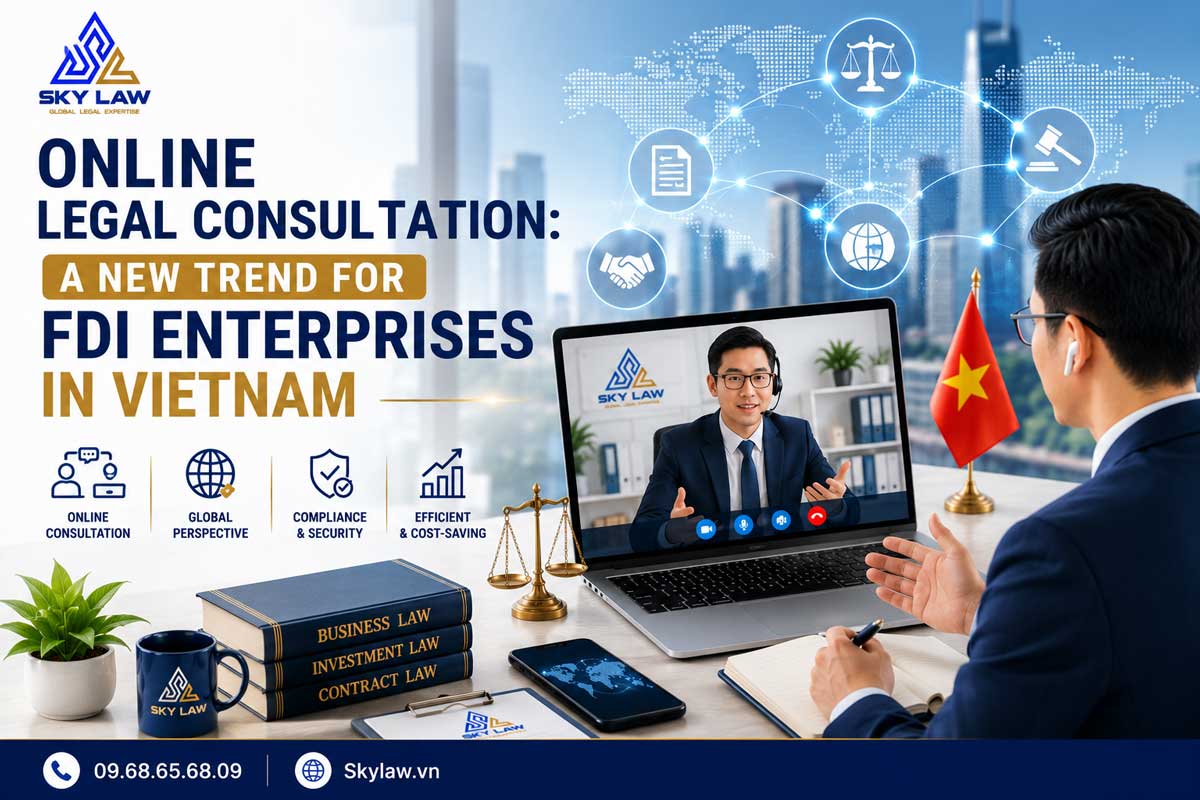
Against the backdrop of robust digital transformation, many foreign-invested enterprises (FDI) in Vietnam are changing their approach to legal services. Instead of meeting lawyers in person at an office, FDI enterprises increasingly prefer online legal consultation through emails, online meetings, document management platforms, and electronic signatures. Therefore, online legal consultation is becoming a new trend in legal advisory activities for FDI enterprises.
For FDI enterprises, legal needs often extend beyond company incorporation to include commercial contracts, labor, taxation, investment, profit remittance, personal data protection, sub-licenses, capital contribution, share purchase, and internal compliance. In many cases, the investors, directors, or internal legal departments of these enterprises are not regularly present in Vietnam. As such, online legal consultation helps FDI enterprises save time, communicate flexibly, and resolve legal issues faster.
The article below analyzes why online legal consultation has become a new trend for FDI enterprises, the legal matters that can be advised online, and key notes for enterprises to utilize this service effectively.
Legal Basis
- Law on Lawyers 2006, as amended and supplemented in 2012;
- Law on Enterprises 2020;
- Law on Investment 2020;
- Civil Code 2015;
- Law on Electronic Transactions 2023;
- Labor Code 2019;
- Decree No. 13/2023/ND-CP on personal data protection.
I. WHAT IS ONLINE LEGAL CONSULTATION?
1.1. Concept of Online Legal Consultation
Online legal consultation can be understood as a form of legal advisory conducted via electronic means instead of face-to-face meetings. Enterprises can send files via email, discuss through online meeting platforms, receive written legal opinions, sign electronic service contracts, and store documents on secure systems.
For FDI enterprises, this format is particularly suitable because many legal decisions require the participation of parent companies, foreign investors, or managers residing in other countries. Online consultation allows all parties to join meetings without geographical limitations.
However, online legal consultation does not mean that all procedures can be completed entirely online. Certain procedures may still require original documents, physical signatures, consular legalization, notarization, authentication, or the submission of physical dossiers as requested by competent state authorities.
1.2. How Does Online Legal Consultation Differ from Traditional Legal Consultation?
Traditional legal consultation typically requires clients to meet lawyers in person, bring hard-copy dossiers, and discuss at the office. Conversely, online legal consultation allows enterprises to prepare, send, and receive documents in digital formats.
The biggest difference lies in flexibility. FDI enterprises can schedule meetings quickly, invite multiple parties to join, share screens to review contracts together, and receive revised versions via email. This makes the legal consultation process better aligned with the operational methods of international businesses.
II. WHY IS ONLINE LEGAL CONSULTATION BECOMING A TREND FOR FDI ENTERPRISES?
2.1. FDI Enterprises Often Have Decision-Makers in Multiple Countries
A common characteristic of FDI enterprises is that decision-makers are not always in Vietnam. Owners, investors, board members, parent companies, or regional legal departments may be based in Singapore, South Korea, Japan, China, Europe, or other countries.
In such cases, online legal consultation enables lawyers in Vietnam to communicate directly with multiple stakeholders simultaneously. Instead of waiting for foreign representatives to fly to Vietnam or routing documents through multiple intermediaries, enterprises can organize online meetings to explain issues, clarify risks, and agree on solutions.
This is particularly useful for matters requiring rapid decisions, such as signing major contracts, resolving disputes with partners, changing management personnel, contributing capital, transferring capital, or presenting explanations to state authorities.
2.2. FDI Enterprises Need to Save Time and Operational Costs
For FDI enterprises, time is a critical factor. Delayed handling of a legal issue can affect investment progress, contract signings, recruitment, or project operations. Waiting for an in-person meeting schedule sometimes fails to match the business pace of international enterprises.
Online legal consultation helps enterprises shorten communication time. Dossiers can be sent in advance, allowing lawyers to study them beforehand so that the online meeting can focus strictly on risk analysis, proposing solutions, and answering specific questions. As a result, enterprises save travel time, administrative costs, and internal resources.
This is why many FDI enterprises choose online legal consultation as a regular working method, especially for matters that do not strictly require face-to-face interactions.
2.3. Alignment with the Digital Work Model of International Enterprises
Many FDI enterprises are already accustomed to operating via internal management systems, corporate emails, online meeting software, e-signatures, and data storage platforms. Therefore, online legal consultation seamlessly integrates into their existing workflow.
Enterprises can share documents based on decentralized access rights, keep a history of correspondence, track contract revision progress, and store legal opinions for internal use. This approach makes legal activities more transparent, systematic, and manageable.
In particular, for corporations with multi-level approval processes, online legal consultation allows the department in Vietnam to easily report back to the parent company using clear, well-grounded documents that can be audited whenever necessary.

III. LEGAL MATTERS THAT FDI ENTERPRISES CAN CONSULT ONLINE
3.1. Commercial Contract Consultation
Contracts are one of the most suitable areas for online legal consultation. FDI enterprises can send draft purchase agreements, service contracts, distribution contracts, agency contracts, factory lease agreements, logistics contracts, or business cooperation contracts (BCC) for lawyers to review.
Lawyers can highlight high-risk clauses, propose amendments, explain legal consequences, and assist enterprises in preparing negotiation strategies. Issues such as payment terms, limitation of liability, indemnification, force majeure, confidentiality, governing law, and dispute resolution can all be analyzed online.
3.2. Investment and Internal Corporate Changes Consultation
FDI enterprises frequently encounter needs regarding changes to charter capital, changes in investors, adding business lines, capital transfers, changes to legal representatives, or adjustments to Investment Registration Certificates (IRC).
These matters can be advised online during the phases of option analysis, checklist preparation, document review, and procedural guidance. However, depending on the specific procedure, enterprises may still need to sign physical dossiers or perform certain steps as required by competent authorities.
3.3. Labor and Human Resources Consultation
FDI enterprises generally have high standards for labor compliance, especially when employing both Vietnamese and foreign workers. Online legal consultation can support enterprises in reviewing labor contracts, salary and bonus policies, internal labor regulations, contract terminations, disciplinary actions, non-disclosure agreements (NDAs), and work permits.
For sensitive situations such as layoffs, downsizing, or labor disputes, lawyers can provide online consultations to ensure the enterprise clearly understands the necessary procedures, required documentation, and potential risks.
3.4. Personal Data Protection and Internal Compliance Consultation
With the growth of e-commerce, technology, HR, and digital marketing, many FDI enterprises process the personal data of customers, employees, partners, or users. Consequently, issues like privacy policies, Data Processing Agreements (DPA), Data Protection Impact Assessments (DPIA), cross-border data transfers, and vendor management are increasingly vital.
These contents can be advised online through questionnaires, data flow diagrams, and meetings with tech, HR, and legal departments. Provided that the enterprise supplies adequate information, online legal consultation can effectively assist in risk assessment and drafting compliance documentation.

IV. KEY NOTES FOR FDI ENTERPRISES USING ONLINE LEGAL CONSULTATION
4.1. Prepare Clear Dossiers Prior to the Consultation
To ensure the effectiveness of an online consultation, FDI enterprises should prepare relevant documents in advance, such as contracts, licenses, charters, email exchanges, labor records, internal policies, or documents regarding the transaction in question. If files are sent beforehand, lawyers can conduct deeper research, allowing the meeting to focus on solutions rather than wasting time clarifying basic facts.
4.2. Identify the Right Participants for the Consultation
Enterprises should invite the appropriate stakeholders to the consultation session, such as legal representatives, HR, finance, operations, parent company representatives, or key decision-makers. This ensures comprehensive information exchange and allows legal strategies to be aligned and approved more rapidly.
4.3. Document Confidentiality and Secure Communication Channels
FDI enterprises routinely handle sensitive materials such as major contracts, customer data, trade secrets, financial data, or investment plans. Therefore, when utilizing online legal consultation, enterprises should select secure communication channels, restrict document access rights, and avoid sending dossiers through inappropriate personal platforms.

V. FREQUENTLY ASKED QUESTIONS
5.1. Can an FDI enterprise handle legal consultation 100% online?
Yes, for matters such as contract reviews, labor consultations, risk assessments, investment structuring, DPAs, DPIAs, and internal compliance. However, certain administrative procedures may still require original hard copies, physical signatures, or direct submissions as prescribed by law.
5.2. Is online legal consultation suitable for foreign investors who are not yet present in Vietnam?
Yes. This is a highly suitable format because foreign investors can consult with Vietnamese lawyers remotely to clearly understand investment conditions, corporate incorporation options, dossier requirements, and risks to note before actual deployment.
5.3. Is online legal consultation secure?
Yes, provided that the parties utilize secure communication channels, agree on the scope of document sharing, and control access permissions. Enterprises should prioritize corporate emails, decentralized storage platforms, and non-disclosure agreements (NDAs) where necessary.
CONCLUSION
Online legal consultation is becoming a prominent new trend for FDI enterprises as it meets the demands for flexibility and speed, while aligning perfectly with international working models. This format enables enterprises to consult with lawyers remotely, save time, reduce operational costs, and handle legal matters more efficiently.
However, for online legal consultation to achieve maximum efficacy, FDI enterprises must prepare comprehensive dossiers, identify the correct participants, ensure document security, and understand the limits of online advice. For procedures requiring original documents, notarization, consular legalization, or face-to-face submissions, enterprises should combine online advisory with the appropriate physical execution steps in compliance with Vietnamese law.


