


Vietnam continues to be an attractive destination for foreign investors thanks to its large consumer market, competitive workforce, strategic location in Southeast Asia, and an increasingly open investment environment. However, to establish a company in Vietnam, foreign investors need to meticulously prepare regarding business lines, capital ownership ratios, legal dossiers, investment procedures, enterprise registration, and post-establishment obligations.
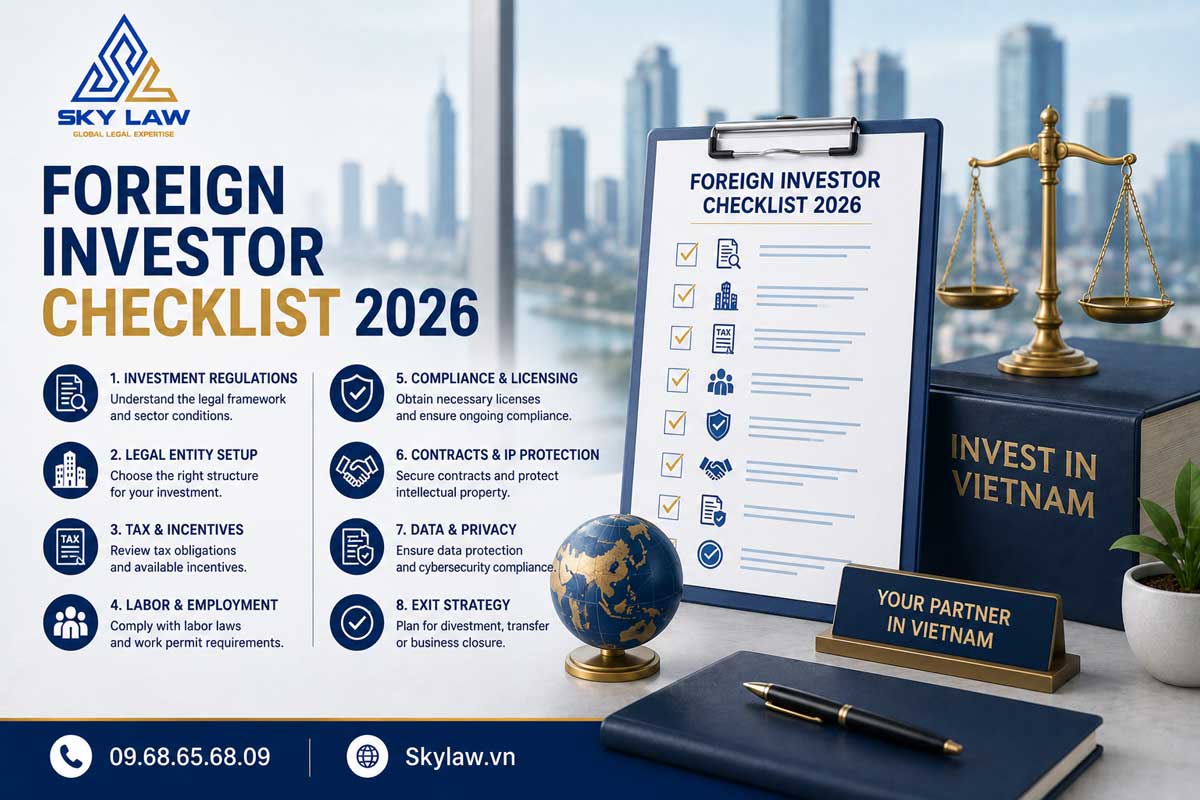
Therefore, the Foreign Investor Checklist 2026 – 10 Steps to Establish a Company in Vietnam is a document that helps investors clearly visualize the steps to be taken before officially operating a business. Comprehensive preparation right from the start will help limit the rejection of dossiers, avoid choosing the wrong type of enterprise, or encountering obstacles when applying for post-establishment licenses.
The article below presents 10 basic steps that foreign investors should keep in mind when establishing a company in Vietnam in 2026.
Legal Basis
- Law on Enterprises 2020;
- Law on Investment 2020;
- Decree No. 31/2021/ND-CP guiding the Law on Investment;
- Decree No. 01/2021/ND-CP on enterprise registration, providing regulations on dossiers, orders, procedures for enterprise registration, and business registration authorities;
- Law on Electronic Transactions 2023;
- Specialized legal regulations applicable to each specific business sector.
I. WHY DO FOREIGN INVESTORS NEED A CHECKLIST BEFORE ESTABLISHING A COMPANY?
1.1. Foreign investment procedures involve more steps than domestic enterprises
Unlike Vietnamese investors, foreign investors usually have to consider market access conditions, capital ownership ratios, forms of investment, Investment Registration Certificates, and requirements for foreign documents. If the dossier involves capital contribution by a foreign organization, the documents may also need consular legalization, translation, and notarization in accordance with regulations.
Therefore, the Foreign Investor Checklist 2026 helps investors not only know what documents to prepare but also understand which sequence to follow first, which contents to check carefully, and which steps may generate additional requirements.
1.2. Proper preparation saves time and cost
If investors choose the wrong business line, register an inappropriate amount of capital, fail to correctly identify the legal representative, or lack parent company documents, the company establishment process can be prolonged. In many cases, investors have to amend dossiers multiple times or alter the investment structure after documents have already been prepared.
Therefore, before submitting a dossier, investors should have a clear checklist to review the entire process of establishing a company in Vietnam.
II. FOREIGN INVESTOR CHECKLIST 2026 – 10 STEPS TO ESTABLISH A COMPANY IN VIETNAM
2.1. Step 1: Determine the intended business lines
The first step is to clearly determine what business fields the company in Vietnam will operate in. Business lines directly affect investment conditions, foreign capital ownership ratios, the licenses required, and the processing time for procedures.
For example, sectors such as trading, distribution, education, logistics, e-commerce, advertising, tourism, finance, healthcare, or real estate may have specific conditions. Investors should not just state general business lines but need to accurately describe actual activities to check the appropriate regulations.
2.2. Step 2: Check market access conditions
After determining the business lines, investors need to check whether that sector allows foreign investors to own 100% of the capital. Some industries allow full foreign ownership, while others have ownership ratio limits, require a Vietnamese partner, or demand specialized licenses.
This is a crucial step in the Foreign Investor Checklist 2026, because if an industry is conditional and the investor does not check in advance, the dossier may not be approved, or the company might be established but unable to apply for an operating license.
2.3. Step 3: Choose the type of enterprise
Foreign investors can choose from popular types such as a single-member limited liability company, a multi-member limited liability company (with two or more members), or a joint-stock company.
If there is only one investor owning the entire capital, a single-member limited liability company is often the simplest choice. If there are two or more investors, a multi-member limited liability company or a joint-stock company may be suitable. If the business plans to raise capital, issue shares, or welcome multiple investors in the future, a joint-stock company is usually more flexible.

2.4. Step 4: Determine capital contribution ratios and ownership structure
Investors need to determine who will contribute capital, how much, in what currency, what the ownership ratio will be, and what the management rights of each party are. If there are both foreign and Vietnamese investors, it is necessary to clarify roles, voting rights, capital transfer rights, and capital contribution responsibilities.
The ownership structure affects not only the establishment dossier but also the control of the company, profit distribution, and future capital-raising capabilities.
2.5. Step 5: Determine charter capital and investment capital
Investors need to consider a charter capital level that fits the business scale, financial capacity, and specialized legal requirements, if any. For some sectors, the law may require minimum capital or proof of financial capacity.
Registered capital should not be too low if the business needs to apply for licenses, lease offices, recruit personnel, or prove its capacity to execute the project. Conversely, registering capital that is too high but failing to contribute it fully and on time can also create legal and corporate governance risks.
2.6. Step 6: Prepare foreign investor documents
Depending on whether the investor is an individual or an organization, the required dossier may vary. Individuals usually need a valid passport and personal information. Foreign organizations usually need a business registration certificate, articles of association or equivalent documents, an investment decision, a power of attorney, and documents of the representative.
Documents issued abroad generally need consular legalization, translation, and notarization before being used in Vietnam. Therefore, investors should prepare this step early to avoid delays.
2.7. Step 7: Select the company’s head office address
A company in Vietnam must have a legal head office address. Investors should check whether the intended address can be used for business registration, especially if using apartments, shared offices, or locations with unclear commercial functions.
For some industries, the business location may also involve conditions regarding area, fire prevention and fighting, specialized licenses, or actual inspection requirements.
2.8. Step 8: Apply for an Investment Registration Certificate if required
In many cases of establishing a foreign-invested company, investors must carry out procedures to apply for an Investment Registration Certificate before registering the enterprise. The National Investment Information System allows investors to register an account, declare information, upload electronic documents, or submit physical dossiers according to the system’s instructions. (FDI Vietnam)
The contents of the investment dossier usually relate to investor information, project objectives, investment capital, execution location, project duration, labor demand, and project implementation commitments.
2.9. Step 9: Register the enterprise at the business registration authority
After completing the investment step if the case requires applying for an Investment Registration Certificate, investors proceed with enterprise registration procedures. Decree No. 01/2021/ND-CP stipulates that the Business Registration Office is the authority that receives, reviews the validity of dossiers, and issues or refuses to issue enterprise registration according to regulations. (THƯ VIỆN PHÁP LUẬT)
Currently, enterprises can perform online enterprise registration procedures through the National Business Registration Portal; management authorities also provide guidance on performing enterprise registration procedures online without having to directly visit the registration office in many cases. (Dang Ky Kinh Doanh)
2.10. Step 10: Complete post-establishment tasks
After being issued the Enterprise Registration Certificate, the company needs to complete post-establishment tasks such as carving the seal if necessary, opening bank accounts, registering for tax, registering digital signatures, initial tax declaration, contributing capital within the deadline, establishing a member or shareholder register, signing labor contracts, and applying for sub-licenses if required by the business lines.
This is a step that many investors easily overlook. In reality, being issued an Enterprise Registration Certificate does not mean the company can fully operate in all sectors. If the business field is conditional, the enterprise must apply for specialized sub-licenses before deploying actual operations.
III. SEVERAL NOTES FOR FOREIGN INVESTORS IN 2026
3.1. Do not rely solely on available templates
Each investment project has different business lines, ownership structures, investor nationalities, locations, and business objectives. Therefore, investors should not just use available templates without checking specific legal conditions.
3.2. Prepare a realistic timeline
The time required to establish a company can vary depending on the industry, locality, completeness of the dossier, and whether foreign documents need consular legalization. Investors should prepare a timeline with a buffer to avoid affecting plans for leasing premises, recruiting personnel, or signing the first contract.
3.3. Seek consultation before contributing capital or signing major contracts
Before transferring capital contributions, signing long-term office leases, or making commitments to partners in Vietnam, investors should carefully check the legal structure. This helps avoid cases where money has been spent but the investment or enterprise registration dossier turns out to be inappropriate.

IV. FREQUENTLY ASKED QUESTIONS
4.1. Can foreign investors own 100% of a company in Vietnam?
Yes, depending on the business lines. Some sectors allow 100% foreign ownership, while others have conditions regarding ownership ratios or investment forms.
4.2. Is it possible to register a business online?
Yes. The National Business Registration Portal supports online business registration and provides guidance on dossiers and business registration procedures. (Dang Ky Kinh Doanh)
4.3. Is it necessary to apply for sub-licenses after establishing the company?
It may be necessary if the business lines fall under conditional sectors. Enterprises should check before operating to avoid the risk of violations.
CONCLUSION
The Foreign Investor Checklist 2026 – 10 Steps to Establish a Company in Vietnam provides foreign investors with a clearer overview of the preparation and implementation process for projects in Vietnam. Key steps include determining business lines, checking market access conditions, choosing the type of enterprise, determining ownership structures, preparing documents, applying for an Investment Registration Certificate if required, registering the enterprise, and completing post-establishment obligations.
Proper preparation right from the beginning will help investors save time, reduce risks, and operate more smoothly when running a business in Vietnam. Before submitting documents, foreign investors should thoroughly review the entire checklist and seek legal counsel if their business lines are conditional or the investment structure is complex.


