


When investing in Vietnam, one of the first questions foreign investors usually ask is: which entity type should foreign investors choose? The choice of legal structure not only affects the enterprise establishment procedures but also impacts management rights, financial liabilities, capital-raising capabilities, capital transfers, and the long-term development strategy of the project.
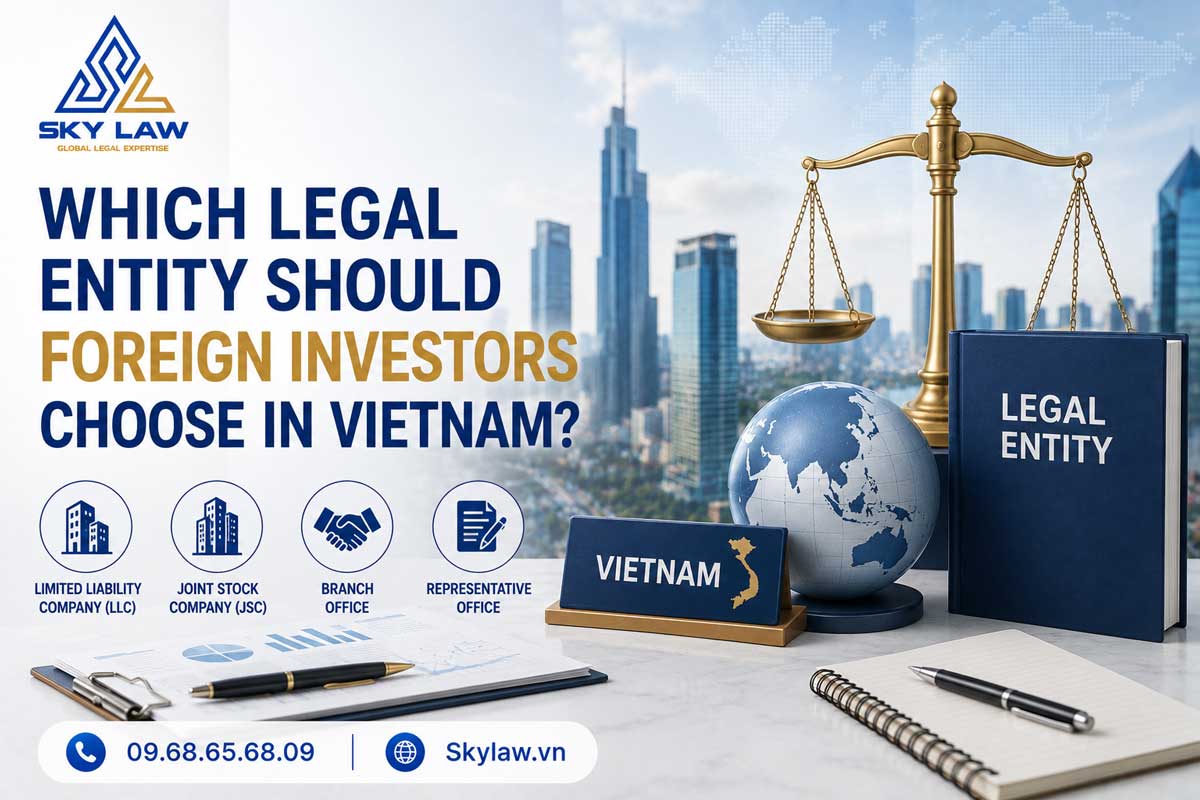
In Vietnam, foreign investors can choose from various forms of presence, such as a single-member limited liability company, a multi-member limited liability company (with two or more members), a joint-stock company, a branch, a representative office, or a business cooperation contract. Each entity type has its own advantages, limitations, and specific conditions for application.
The article below analyzes the popular entity types to help foreign investors gain a clearer understanding before deciding to establish an enterprise or deploy business operations in Vietnam.
Legal Basis
- Law on Enterprises 2020;
- Law on Investment 2020;
- Civil Code 2015;
- Decree No. 31/2021/ND-CP guiding the Law on Investment;
- Decree No. 01/2021/ND-CP on enterprise registration.
I. WHAT SHOULD FOREIGN INVESTORS CONSIDER BEFORE CHOOSING AN ENTITY TYPE?
1.1. Investment Objectives in Vietnam
Before deciding which entity type to choose, foreign investors must clearly define their investment objectives. If the objective is to directly conduct business, sign contracts, issue invoices, recruit personnel, and generate revenue in Vietnam, establishing a company is usually the most suitable choice.
Conversely, if the investor only wants to survey the market, promote trade, contact partners, or research investment opportunities, a representative office can be an initial option. However, a representative office is generally not permitted to directly conduct revenue-generating activities in Vietnam.
If an investor wants to cooperate with a Vietnamese enterprise but does not yet want to establish a new legal entity, a business cooperation contract (BCC) can be considered. However, this form requires a clear agreement on the rights, obligations, profit-sharing, cost management, and responsibilities of each party.
1.2. Number of Investors and Ownership Structure
The number of investors is a crucial factor when choosing an enterprise structure. If there is only one foreign investor owning the entire capital, a single-member limited liability company is often the simplest and easiest option to manage.
If there are two or more investors, or if there is a combination of foreign and Vietnamese investors, a multi-member limited liability company or a joint-stock company may be more appropriate.
For projects with plans to raise capital, issue shares, or attract multiple investors in the future, a joint-stock company typically offers greater flexibility. However, this type also comes with more complex governance requirements compared to a limited liability company.
1.3. Business Lines and Market Access Conditions
Not all business sectors in Vietnam allow foreign investors to own 100% of the capital. Certain business lines come with conditions regarding ownership percentages, investment forms, Vietnamese partners, sub-licenses, statutory capital, experience, or scope of operation.
Therefore, before selecting an entity type, investors must check the market access conditions for their intended business lines. This is a critical step because even with the same corporate structure, the feasibility of obtaining a license can vary depending on the investment sector.
Example: Sectors such as distribution, education, logistics, e-commerce, advertising, tourism, finance, or certain specialized services may require additional consideration of specific conditions.

II. POPULAR ENTITY TYPES FOR FOREIGN INVESTORS
2.1. Single-Member Limited Liability Company (Single-Member LLC)
A single-member limited liability company is an enterprise type owned by a single organization or individual. For foreign investors who wish to fully own their business in Vietnam, this is a highly popular choice.
- Advantages: Relatively simple management structure; the owner holds full decision-making power over major company matters; and the owner’s liability is limited to the amount of contributed capital. This is ideal for investors who want absolute control over their business operations in Vietnam.
- Limitations: It is not suitable if the investor plans to bring in multiple shareholders or raise capital by issuing shares. When expanding the ownership structure, the enterprise may need to convert its corporate form or undergo procedures to change members or owners.
2.2. Multi-Member Limited Liability Company (Two or More Members)
A multi-member limited liability company is suitable when there are between 2 and 50 capital-contributing members. Members can be individuals, organizations, foreign investors, or Vietnamese investors.
- Advantages: Ideal for cases where a foreign investor partners with a Vietnamese counterpart or when multiple investors jointly participate in a project. Each member’s liability is limited to their contributed capital share, reducing personal financial risk. The governance structure is less complex than that of a joint-stock company while still allowing ownership division among multiple members.
- Limitations: The transfer of capital contributions is usually subject to stricter internal controls compared to transferring shares in a joint-stock company.
Therefore, if investors prefer to keep the ownership structure stable, restrict outsiders from joining the company, and prioritize internal control, a multi-member LLC is a compelling option.
2.3. Joint-Stock Company (JSC)
A joint-stock company is a type of enterprise whose charter capital is divided into shares, requiring a minimum of three shareholders. This structure is typically suited for projects aimed at fundraising, scaling up, or involving numerous investors.
- Advantages: The biggest advantage of a joint-stock company is its flexible capital mobilization capability. The company can issue additional shares, accept new shareholders, and transfer shares relatively more conveniently than an LLC. For foreign investors with long-term growth plans in Vietnam—especially in technology, manufacturing, trade, or models with fundraising potential—a JSC is highly suitable.
- Limitations: It features a more complex corporate governance structure. The business must manage the General Meeting of Shareholders, the Board of Directors, voting rights, preferred shares, share transfers, and shareholder relations. Without a clear Charter and Shareholder Agreement, internal disputes can easily arise as the business grows.
2.4. Representative Office (RO)
A representative office is the right choice when a foreign trader wants a presence in Vietnam to conduct market research, engage in trade promotion, contact partners, or support the operations of the parent company. It is not an entity meant to directly conduct business to generate revenue in Vietnam.
- Advantages: Highly suitable for the market exploration phase. Investors can learn about customers, partners, the business environment, and legal regulations before committing to establishing a company.
- Limitations: The biggest restriction is that an RO cannot directly perform revenue-generating activities. Therefore, if investors intend to sign sales contracts, provide services, issue invoices, or directly generate revenue in Vietnam, establishing a company is a better fit.
2.5. Branch of a Foreign Trader
A branch is a form of presence of a foreign trader in Vietnam that can perform certain business operations within its licensed scope. However, not all sectors are suitable or permitted to establish branches.
Compared to a representative office, a branch has a wider scope of business activity, but its establishment and management requirements are usually more complex. Investors must carefully check sector-specific regulations before choosing this form.
While branches are viable in a few sectors where the law explicitly allows foreign traders to set them up for business, in practice, many investors still prefer establishing a company. A Vietnamese legal entity is generally much more convenient for signing contracts, recruiting, opening bank accounts, applying for licenses, and running daily operations.
2.6. Business Cooperation Contract (BCC)
A business cooperation contract is a form where parties collaborate to conduct business activities without necessarily establishing a new legal entity. Foreign investors can cooperate with Vietnamese partners to jointly deploy a project, sharing profits and responsibilities as agreed.
- Advantages: Highly flexible; suitable when parties want to test a cooperation model or are not yet ready to establish a new company.
- Limitations: Risks lie in cash flow management, profit sharing, cost control, management rights, and liabilities if disputes arise.
Therefore, if choosing a BCC, investors must draft a rigorous contract that explicitly outlines the scope of cooperation, management mechanisms, inspection rights, reporting obligations, and dispute resolution methods.
III. WHICH ENTITY TYPE SHOULD FOREIGN INVESTORS CHOOSE?
3.1. For 100% Ownership and Simple Management
If a foreign investor wants to solely own and control the entire enterprise in Vietnam, a single-member limited liability company is generally the most appropriate choice. This model is straightforward, easy to manage, and fits businesses that do not yet have complex fundraising needs.
3.2. For Cooporating with Vietnamese Partners or Multiple Investors
If there are multiple capital-contributing members or a Vietnamese partner involved, a multi-member limited liability company is the way to go, especially when the parties want tight control over capital transfers and wish to maintain a stable member structure.
3.3. For Plans Involving Fundraising or Aggressive Expansion
If the project plans to raise capital, issue shares, or bring on many investors in the future, a joint-stock company is usually the better option. However, investors must prepare a clear company Charter and Shareholder Agreement to prevent future disputes.
IV. FREQUENTLY ASKED QUESTIONS
4.1. Can foreign investors own 100% of a company in Vietnam?
Yes, depending on the business line. Many sectors allow 100% foreign ownership, while some specific sectors have strict conditions regarding ownership ratios or required investment forms.
4.2. Can a representative office do business in Vietnam?
Generally, no. A representative office is not allowed to directly engage in revenue-generating activities in Vietnam. This form is strictly meant for trade promotion, market research, and partner relations.
4.3. Which Is Better for Foreign Investors: LLC or Joint-Stock Company?
There is no one-size-fits-all answer. An LLC is best for simpler models with fewer investors that prioritize internal control. A JSC is more suitable if the business plans to raise capital, issue shares, or scale significantly.
Conclusion
The decision on which entity type to choose for a foreign investor depends heavily on investment objectives, the number of investors, business lines, fundraising plans, control requirements, and long-term development strategies in Vietnam.
- For sole ownership and simple management, a single-member LLC is ideal.
- For collaboration among multiple investors, a multi-member LLC or a JSC should be considered.
- To simply test the waters, a representative office is a great first step.
Before making a final decision, foreign investors should thoroughly review market access conditions, conditional business lines, licensing requirements, and an optimal ownership structure. Choosing the right entity type from the very beginning will ensure that the process of establishment, operation, and business expansion in Vietnam proceeds as smoothly as possible.


